Overnight oats: the base ratio and make-ahead jars
Vegan overnight oats with the right ratio of rolled oats, chia and plant milk, why rolled oats work best, five flavor ideas and how long the jars keep.
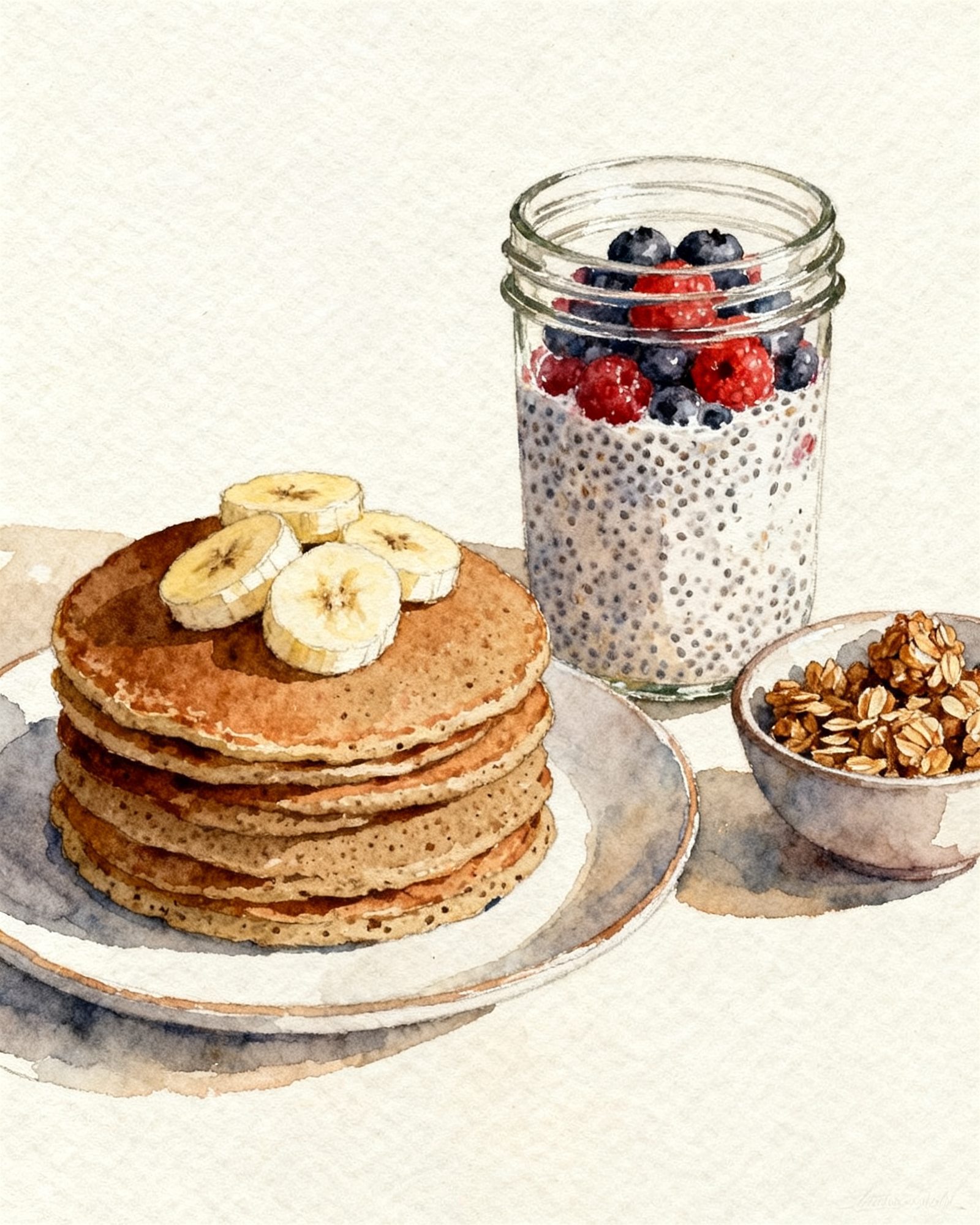
Makes About 2 cups, 2 jars
Ingredients
- 1 cup (81 g) old-fashioned rolled oats, not quick or steel-cut
- 2 tbsp chia seeds
- 1/4 tsp ground cinnamon
- 1/8 tsp fine salt
- 1 1/2 cups (360 ml) unsweetened soy milk, or another plant milk
- 1 tbsp maple syrup
- 1/2 tsp vanilla extract
To serve
- 1 cup (150 g) fresh blueberries or other berries (optional)
Equipment
- Two 1-pint jars with lids, or one mixing bowl
- Spoon or small whisk
Method
Divide the oats, chia seeds, cinnamon and salt between two 1-pint jars (or put them all in one bowl) and stir to mix.
Pour in the soy milk, maple syrup and vanilla, dividing them evenly, and stir well, scraping the bottom so no dry oats or clumps of chia remain.
Let stand for 5 minutes, then stir again. The chia seeds start to gel in the first minutes and this second stir keeps them from setting in lumps at the bottom.
Cover and refrigerate for at least 6 hours, or overnight, until the oats are soft and the mixture is thick and creamy.
Stir before eating. If it is thicker than you like, loosen it with a splash of milk. Top with the berries and eat cold, or warm it in a microwave-safe bowl, stirring every 30 seconds, until heated through.
Nutrition per serving
| Calories | 290 |
|---|---|
| Total fat | 9 g |
| Saturated fat | 1 g |
| Carbohydrate | 42 g |
| Fiber | 9 g |
| Total sugars | 8 g |
| Protein | 12 g |
| Sodium | 220 mg |
| Calcium | 330 mg |
| Iron | 3.4 mg |
Per serving, calculated from USDA FoodData Central values for the ingredients and amounts listed, leaving out the optional ingredients. Calories, fat, carbohydrate, fiber, sugars, protein and sodium are rounded with the FDA Nutrition Facts label rules; calcium is shown to the nearest 10 mg and iron to the nearest 0.1 mg. Brands differ, so treat the figures as estimates.
How these numbers were calculated
Each ingredient as weighed for the calculation and the USDA FoodData Central record its nutrients come from. Where USDA has no record for an ingredient (vegan butter, nutritional yeast, coconut sugar), the closest generic record is used and named here.
| Ingredient | Grams | USDA record |
|---|---|---|
| 1 cup (81 g) old-fashioned rolled oats, not quick or steel-cut | 81 g | FDC 173904: Cereals, oats, regular and quick, not fortified, dry (SR Legacy). Weight from: USDA portion '1 cup' |
| 2 tbsp chia seeds | 21 g | FDC 2707590: Chia seeds (FNDDS 2021-2023). Weight from: USDA portion '1 cup' (1 cup = 16 tbsp = 48 tsp) |
| 1/4 tsp ground cinnamon | 0.7 g | FDC 171320: Spices, cinnamon, ground (SR Legacy). Weight from: USDA portion '1 tsp' |
| 1/8 tsp fine salt | 0.8 g | FDC 173468: Salt, table (SR Legacy). Weight from: USDA portion '1 tsp' |
| 1 1/2 cups (360 ml) unsweetened soy milk, or another plant milk | 364.5 g | FDC 175215: Soymilk (all flavors), unsweetened, with added calcium, vitamins A and D (SR Legacy). Weight from: USDA portion '1 cup' |
| 1 tbsp maple syrup | 20 g | FDC 169661: Syrups, maple (SR Legacy). Weight from: USDA portion '1 tbsp' |
| 1/2 tsp vanilla extract | 2.1 g | FDC 173471: Vanilla extract (SR Legacy). Weight from: USDA portion '1 tsp' |
| 1 cup (150 g) fresh blueberries or other berries (optional) | not counted (optional) | FDC 171711: Blueberries, raw (SR Legacy). Weight from: USDA portion '1 cup' |
Overnight oats are rolled oats left to soak in plant milk in the refrigerator, so by morning they are soft, creamy and ready to eat with a spoon, cold or warmed. There is no cooking, and a batch of jars made on Sunday covers several breakfasts. The only things that decide whether they turn out creamy or gluey, soupy or dry, are the ratio of oats to liquid and the kind of oats. This version uses a tablespoon of chia seeds in each jar for a thicker, pudding-like texture, and the milk is measured to match.
The ratio, and how chia changes it
Rolled oats absorb most of their own volume of liquid overnight. That is why the simplest version is equal parts oats and plant milk by volume: 1/2 cup of each per jar makes soft oats with a little loose milk around them.
Chia seeds absorb liquid too, and far more for their size. As in chia pudding, they need about four times their volume in liquid to set properly. So for each tablespoon of chia you add, add 1/4 cup more milk. That gives the card’s jar: 1/2 cup oats, 1 tablespoon chia seeds and 3/4 cup milk.
From there, adjust to taste:
| You want | Change per jar |
|---|---|
| Looser, more like cereal and milk | Add 2 to 4 tablespoons more milk |
| Thick enough to hold a spoon upright | Add an extra teaspoon of chia seeds and no extra milk |
| No chia | Use 1/2 cup oats and 1/2 cup milk |
| A tangy, richer jar | Replace 1/4 cup of the milk with plain plant-based yogurt |
The mixture keeps thickening in the refrigerator, so a jar that seems runny at night is usually right by morning. If it is too thick when you open it, stir in a splash of milk.
How long they need to soak
The card says at least 6 hours, and overnight is easiest. Rolled oats are edible after about 2 hours, but at that point they are still chewy in the middle and the chia is only partly set; the creamy, fully softened texture comes with the longer soak.
Which milk
Any plant milk works, and so does water, though water gives a thin, flat-tasting jar. Soy milk, used on the card, is the creamiest of the common unsweetened options and carries the most protein; oat milk is slightly sweet; almond milk is lighter and thinner. A carton coconut milk beverage works, mixed half and half with another milk; canned coconut milk is too rich on its own.
Rolled, quick or steel-cut oats
The kind of oat matters more than anything else in the jar.
- Old-fashioned rolled oats are whole oat groats that have been steamed and flattened. They are thin enough to soften completely in a night but keep a little chew. These are the ones to use.
- Quick oats are rolled thinner and cut smaller. They soften in an hour or two and by morning have turned soft and pasty, with no texture left.
- Steel-cut oats are groats chopped into pieces, not flattened. They stay firm and chewy after soaking and taste half raw. They are much better cooked on the stove.
The card’s nutrition is calculated from USDA’s record for rolled and quick oats. For how oats fit into the fiber picture, see dietary fiber explained.
Why the second stir matters
Chia seeds start to gel within minutes of meeting liquid. Seeds that have sunk to the bottom of the jar during that time glue together into a dense clump. Stirring once when you add the milk and again 5 minutes later breaks them up while the gel forms, and the jar sets evenly. Scrape the bottom on the second stir, because that is also where dry oats hide.
Chia seeds should always be eaten soaked. The American College of Gastroenterology notes that they “should only be mixed with sufficient amounts of liquid to allow them to expand before consumption,” which a night in milk takes care of.
Six flavor combinations
Each one is for a single jar made from the card’s base. Stir the first items in at night and add the toppings in the morning. Additions change the nutrition on the card, which counts only the base.
- Peanut butter and banana. At night, stir in 1 tablespoon peanut butter. In the morning, top with half a sliced banana.
- Apple pie. At night, stir in half a small apple, grated, and an extra pinch of cinnamon; the apple softens into the oats. In the morning, top with a tablespoon of chopped walnuts.
- Chocolate. At night, whisk 1 tablespoon unsweetened cocoa powder and an extra teaspoon of maple syrup into the milk before adding it to the oats, so the cocoa does not clump. Top with raspberries.
- Mango and coconut. Use half coconut milk beverage and half soy milk. In the morning, top with diced mango, a little grated lime zest and toasted coconut flakes.
- Pumpkin spice. At night, stir in 1/4 cup canned pumpkin puree and 1/4 teaspoon pumpkin pie spice, and use 2 tablespoons less milk, since the pumpkin loosens the jar. Top with chopped pecans.
- Berry crunch. Make the jar as written. In the morning, top with berries and a handful of maple almond granola, added just before eating so it stays crisp.
More protein in the jar
The soy milk on the card already carries more protein than most other plant milks; the plant-based protein guide compares common sources. To add more without changing the method:
- Hemp seeds: stir 1 to 2 tablespoons into the jar at night. They do not absorb much liquid, so the ratio stays the same.
- Plant-based yogurt: replace 1/4 cup of the milk with plain soy yogurt for a thicker, tangier jar.
- Plant protein powder: whisk it into the milk first so it does not clump, and add 2 to 4 tablespoons more milk per scoop, because powder absorbs liquid and the jar sets much thicker. Unflavored or vanilla powders fit most flavors; the protein and sugar per scoop vary widely, so check the label.
- Peanut butter: the peanut butter and banana jar below adds protein along with flavor.
Make-ahead jars and how long they keep
Overnight oats are made for batch prep. Mix up to four days of jars at once, cover them tightly and keep them in the refrigerator at 40°F or below. Eat them within 3 to 4 days, the window the USDA Food Safety and Inspection Service gives for refrigerated leftovers.
The texture changes over those days: by the third or fourth morning the oats are softer and the jar is thicker, so you may want a splash of milk. Keep fresh fruit, nuts, seeds and granola separate until the morning you eat the jar. Cut fruit weeps juice into the oats, bananas turn brown, and nuts and granola go soft.
For one big batch instead of jars, multiply the card in a lidded container and spoon out a portion each morning with a clean spoon; the same 3- to 4-day limit applies. Overnight oats can also be frozen in portions: FoodSafety.gov notes that freezer storage times are for quality only, and the oats come out softer after thawing overnight in the refrigerator, so stir in a splash of milk and add fresh toppings.
Cold or warm
Most people eat overnight oats straight from the refrigerator, but they are good warm too. Tip a jar into a microwave-safe bowl and heat it in short bursts, stirring every 30 seconds, until heated through, or warm it in a small saucepan over low heat. Add a splash of milk first, since the oats thicken as they heat. Add any fresh fruit after warming.
Mistakes and fixes
- Dry oats at the bottom of the jar. They were not stirred down into the milk. Stir well and scrape the bottom, twice.
- Gluey and too thick. Too many oats or chia seeds for the liquid, or quick oats. Loosen with milk, and use rolled oats next time.
- Thin and soupy. Too much milk, or not enough time. Give it the full 6 hours, or add a teaspoon of chia and wait 20 minutes.
- Bland. Oats need the 1/8 teaspoon of salt and some sweetness to taste of anything. Do not skip the salt, cinnamon or vanilla.
Gluten and allergy notes
Oats do not contain wheat, but the National Institute of Diabetes and Digestive and Kidney Diseases (NIDDK) warns that cross-contact between oats and grains that contain gluten “is common and can make oats unsafe for people with celiac disease.” If you have celiac disease, use certified gluten-free oats.
The recipe as written contains soy (in the soy milk). For a soy-free version, use oat milk, or almond milk if tree nuts are not a concern; the plant milk comparison shows how they differ. The peanut butter, apple pie and pumpkin spice variations add peanuts and tree nuts (walnuts, pecans), soy yogurt adds more soy, the mango version adds coconut, and the granola topping contains almonds.
For a warm breakfast on days with more time, try vegan buckwheat pancakes; a frozen batch reheats in a toaster on busy mornings.
Common questions
What is the ratio for overnight oats?
Equal volumes of rolled oats and plant milk give a soft, spoonable texture: 1/2 cup oats to 1/2 cup milk for one jar. If you add chia seeds, add 1/4 cup more milk for every tablespoon of chia, because the seeds absorb liquid too. That is where the recipe's 1/2 cup oats, 1 tablespoon chia and 3/4 cup milk per jar come from.
Can I use steel-cut or quick oats for overnight oats?
Steel-cut oats stay hard and chewy after a night of soaking, so they are not a good fit for this method. Quick oats work but go soft and pasty, with no texture left. Old-fashioned rolled oats soften fully while keeping some bite.
How long do overnight oats need to soak?
At least 6 hours in the refrigerator, and overnight is easiest. The oats are edible after about 2 hours but still chewy in the middle, and the chia seeds are only partly set; the long soak is what makes them soft and creamy.
How long do overnight oats last in the fridge?
Keep the jars covered at 40°F or below and eat them within 3 to 4 days, the window USDA gives for refrigerated leftovers. The oats get softer each day, so add fresh fruit, nuts and granola on the morning you eat them.
Can I eat overnight oats warm?
Yes. Tip the oats into a microwave-safe bowl and heat them, stirring every 30 seconds, until hot, or warm them in a small saucepan over low heat. Add a splash of milk, because they thicken as they heat.
Are overnight oats gluten-free?
Oats are not wheat, but the NIDDK says cross-contact between oats and grains that contain gluten is common, and it can happen when foods are grown, processed, stored, prepared or served. If you have celiac disease, use certified gluten-free oats; the NIDDK tells people with celiac disease who eat oats to "make sure they are gluten-free."
Sources
Read next
Chia pudding: the ratio, the method and five flavors
How to make chia seed pudding that sets thick and smooth: the 1-to-4 ratio of seeds to plant milk, the second stir that stops clumps, flavors and storage.
Tofu scramble that tastes like breakfast
A tofu scramble with soft curds and an eggy note: which tofu to buy, how dry it should be, turmeric, nutritional yeast and kala namak, plus vegetables to add.
Maple almond granola with big clusters
Big-cluster homemade granola with maple and almonds: press it flat, bake at 325°F without stirring, cool it untouched. Plus a chocolate version.
Omega-3s from plant foods: ALA, EPA, DHA and algae
ALA, EPA and DHA explained: adult Adequate Intakes for ALA, the richest plant sources, why conversion is limited, and algal oil as a vegan omega-3 source.
Chia seeds: nutrition and how to eat them
Chia seeds nutrition per ounce and per tablespoon from USDA data, their omega-3 and calcium, why they must be soaked before eating, and ways to use them.