Maple almond granola with big clusters
Homemade maple almond granola with big crunchy clusters: press it flat, bake at 325°F without stirring, cool it untouched. Plus a chocolate version.
Makes About 4 1/2 cups, 9 servings of 1/2 cup
Ingredients
- 3 cups (245 g) old-fashioned rolled oats, not quick or instant
- 1 cup (145 g) whole raw almonds, coarsely chopped
- 1/2 tsp ground cinnamon
- 1/2 tsp fine salt
- 1/2 cup (120 ml) maple syrup
- 1/4 cup (60 ml) canola oil, or melted coconut oil
- 1 tsp vanilla extract
To finish
- 1/2 cup (80 g) raisins or other chopped dried fruit, added after baking (optional)
Equipment
- Rimmed half-sheet baking pan (about 13 by 18 inches)
- Parchment paper
- Chef's knife and cutting board
- Large mixing bowl
- Small bowl or 2-cup measure
- Whisk
- Flexible spatula
- Airtight jar or container
Method
Set a rack in the center of the oven and heat the oven to 325°F (165°C). Line a rimmed half-sheet pan with parchment paper.
In a large mixing bowl, stir together the oats, chopped almonds, cinnamon and salt.
In a small bowl or 2-cup measure, whisk the maple syrup, canola oil and vanilla until the oil is evenly dispersed.
Pour the syrup mixture over the oat mixture and fold with a flexible spatula for about 1 minute, until every oat flake looks glossy and no dry patches remain at the bottom of the bowl.
Tip the mixture onto the lined pan and spread it into an even layer that covers almost the whole pan. Press it down very firmly with the spatula or the flat bottom of a measuring cup until it is compact, with no loose gaps.
Bake for 20 minutes, then rotate the pan front to back without stirring the granola.
Bake for another 15 to 20 minutes, until the granola is evenly golden brown across the surface and smells toasty, and the edges are a shade darker than the center. The center still feels slightly soft when pressed; it crisps as it cools. If the edges darken quickly in the last minutes, take the pan out early.
Set the pan on a rack and let the granola cool completely, without touching it, for at least 45 minutes, until it is hard and crisp all the way through.
Lift the parchment, break the granola into clusters of the size you like, stir in the dried fruit if using, and store in an airtight jar at room temperature.
Nutrition per serving
| Calories | 300 |
|---|---|
| Total fat | 16 g |
| Saturated fat | 1.5 g |
| Carbohydrate | 34 g |
| Fiber | 5 g |
| Total sugars | 12 g |
| Protein | 7 g |
| Sodium | 135 mg |
| Calcium | 80 mg |
| Iron | 1.8 mg |
Per serving, calculated from USDA FoodData Central values for the ingredients and amounts listed, leaving out the optional ingredients. Calories, fat, carbohydrate, fiber, sugars, protein and sodium are rounded with the FDA Nutrition Facts label rules; calcium is shown to the nearest 10 mg and iron to the nearest 0.1 mg. Brands differ, so treat the figures as estimates.
How these numbers were calculated
Each ingredient as weighed for the calculation and the USDA FoodData Central record its nutrients come from. Where USDA has no record for an ingredient (vegan butter, nutritional yeast, coconut sugar), the closest generic record is used and named here.
| Ingredient | Grams | USDA record |
|---|---|---|
| 3 cups (245 g) old-fashioned rolled oats, not quick or instant | 243 g | FDC 173904: Cereals, oats, regular and quick, not fortified, dry (SR Legacy). Weight from: USDA portion '1 cup' |
| 1 cup (145 g) whole raw almonds, coarsely chopped | 143 g | FDC 170567: Nuts, almonds (SR Legacy). Weight from: USDA portion '1 cup, whole' |
| 1/2 tsp ground cinnamon | 1.3 g | FDC 171320: Spices, cinnamon, ground (SR Legacy). Weight from: USDA portion '1 tsp' |
| 1/2 tsp fine salt | 3 g | FDC 173468: Salt, table (SR Legacy). Weight from: USDA portion '1 tsp' |
| 1/2 cup (120 ml) maple syrup | 157.5 g | FDC 169661: Syrups, maple (SR Legacy). Weight from: USDA portion '1 cup' |
| 1/4 cup (60 ml) canola oil, or melted coconut oil | 54.5 g | FDC 172336: Oil, canola (SR Legacy). Weight from: USDA portion '1 cup' |
| 1 tsp vanilla extract | 4.2 g | FDC 173471: Vanilla extract (SR Legacy). Weight from: USDA portion '1 tsp' |
| 1/2 cup (80 g) raisins or other chopped dried fruit, added after baking (optional) | not counted (optional) | FDC 2709212: Raisins (FNDDS 2021-2023). Weight from: USDA portion '1 cup' |
Maple almond granola is rolled oats and chopped almonds coated in maple syrup, a little oil, vanilla and cinnamon, then baked until golden and crisp. Homemade granola often comes out as loose, crumbly flakes, while many boxed granolas come in chunky clusters. The difference is not a secret ingredient but technique: this recipe presses the granola into a firm layer, bakes it without stirring, and leaves it alone to cool, so it breaks into large, crunchy pieces.
Where the clusters come from
Maple syrup is mostly sugar dissolved in water. In the oven the water evaporates and the sugar thickens into a sticky coating on every oat flake and nut. While the granola is hot that coating is soft; as it cools, it sets hard, like a thin layer of caramel, and anything touching at that moment stays stuck together.
That gives three rules:
- Press it. Pressing the coated oats firmly onto the pan, with a spatula or the flat bottom of a measuring cup, puts the flakes in close contact so the syrup can bridge them. A loose, fluffy layer bakes into loose, fluffy granola.
- Do not stir. Many granola recipes tell you to stir halfway through, which is exactly what breaks clusters apart. Rotate the pan instead, so it browns evenly without being disturbed.
- Cool it completely, untouched. Give it the full 45 minutes on a rack. Break it up while warm and the pieces crumble; break it up cold and it snaps into clusters as large as you want.
Oven temperature and timing
A moderate oven, 325°F (165°C), toasts the oats and almonds all the way through before the sugar on the surface has a chance to burn. Hotter ovens brown the edges of the pan long before the center is done, and since this granola is not stirred, the edges would scorch.
Bake for 20 minutes, rotate the pan front to back, then bake for another 15 to 20 minutes. Ovens differ, so watch for these signs rather than relying on the timer alone:
- the whole surface is evenly golden brown, with the edges a shade darker than the middle;
- the kitchen smells of toasted oats and nuts, not of anything sharp or bitter;
- the center still gives slightly when pressed. That is right: it hardens as it cools.
Granola recipes range from a slow, low oven to a hot one, and the hot ones usually ask you to stir every few minutes so the edges do not burn. Stirring is exactly what this recipe avoids, which is why it sits in the middle: hot enough to toast the almonds through in under an hour, gentle enough that an unstirred slab browns evenly.
Dark metal pans brown faster than light ones; check a few minutes early if yours is dark. Lining the pan with parchment keeps the sugary bottom layer from welding itself to the metal.
Chocolate granola
For a granola with the flavor of a chocolate breakfast cereal, whisk 3 tablespoons of unsweetened cocoa powder and an extra tablespoon of maple syrup into the syrup mixture before pouring it over the oats. Cocoa powder lumps easily, so whisk until the mixture is completely smooth. Everything else stays the same.
Because cocoa granola is dark from the start, you cannot judge it by color. Go by time, by the toasted smell, and by the edges, which should feel dry and firm. If you want chocolate pieces, stir in dairy-free dark chocolate chips after the granola has cooled completely; added earlier, they turn liquid and smear.
Almond butter or peanut butter granola
For maple almond butter granola, whisk 1/3 cup of smooth, runny almond butter into the maple syrup mixture until smooth and cut the oil to 2 tablespoons. The nut butter makes the coating thicker and stickier, so the clusters come out even larger and the flavor is more deeply nutty. For a peanut butter version, use the same amount of smooth peanut butter, and roasted unsalted peanuts can replace the almonds. Either way, nut butter browns faster than plain syrup, so start checking at the 30-minute mark. It is not a puffed cereal, but it gives the same peanut-butter-and-crunch breakfast. The peanut version contains peanuts as well as the almonds, unless you swap them.
Other versions people ask for
- Maple almond cranberry: stir 1/2 cup of dried cranberries into the cooled granola instead of the raisins on the card. Like any dried fruit, they go in after baking.
- Coconut: scatter 1/2 cup of unsweetened coconut flakes over the slab for the last 10 minutes of baking, and use melted coconut oil. The granola then contains coconut.
- With buckwheat: replace 1 cup of the oats with 1 cup of raw buckwheat groats (whole kernels, not flour). They stay crunchy and add a toasty flavor.
- With protein powder: stir 1/4 cup of unflavored or vanilla plant protein powder into the dry oats and add 1 to 2 extra tablespoons of maple syrup so everything is still coated. The powder browns quickly and can taste chalky if overused, so do not add more.
- Granola bars: this recipe is a crunchy granola, not a chewy bar. For crisp, breakable bars, cut the pressed slab into bars with a sharp knife as soon as it comes out of the oven, while it is still soft, then leave it to cool completely before separating them. They are more fragile than store-bought bars, which use more binder.
- Double batch: use two lined pans on racks in the upper and lower thirds of the oven, and swap them top to bottom as well as rotating them at the 20-minute mark. Two pans in one oven may need a few extra minutes.
Add-ins: before or after baking
What goes in before the oven and what goes in after makes a big difference.
| Before baking | After baking and cooling |
|---|---|
| Other nuts: pecans, walnuts, cashews, hazelnuts | Raisins, dried cherries, chopped dates or apricots |
| Seeds: pumpkin, sunflower, sesame | Dairy-free dark chocolate chips |
| Ground spices: ginger, cardamom, nutmeg | Freeze-dried fruit |
| Unsweetened coconut flakes (scatter over the top for the last 10 minutes only; they brown fast) | Cacao nibs |
Dried fruit baked with the granola dries out, hardens and can burn. Fresh fruit never goes into the jar at all: add it in the bowl, just before eating.
Swaps that work and ones that do not
- Sweetener. Agave syrup or brown rice syrup can replace maple syrup cup for cup, with a slightly different flavor; agave browns a little faster, so watch the end of baking closely. Honey works the same way but is not vegan. Granulated sugar alone does not coat the oats; the recipe needs a liquid sweetener. For how the common sweeteners differ, see natural sweeteners compared.
- Oil. Canola or another neutral oil keeps the maple flavor in front. Melted coconut oil gives a crisper, faintly coconut-flavored granola. Olive oil works too and adds a fruity note.
- Nuts. Any nut can replace the almonds. For a nut-free granola, use 1 cup of pumpkin and sunflower seeds instead.
- Oats. Old-fashioned (or thick-cut) rolled oats are what this recipe needs. Quick oats are thinner and smaller, so they bake into a finer, less chunky granola; steel-cut oats stay hard and do not toast through. For what rolled oats contain, see rolled oats nutrition on DataFood.
Oats and gluten
Oats do not contain wheat, but they are often grown and processed alongside it. The National Institute of Diabetes and Digestive and Kidney Diseases (NIDDK) says that most people with celiac disease can probably eat moderate amounts of oats safely, tells anyone who eats oats to “make sure they are gluten-free,” and adds that cross-contact between oats and gluten-containing grains “is common and can make oats unsafe for people with celiac disease.” If you have celiac disease, use certified gluten-free oats, and check the labels of the other ingredients for cross-contact as well.
Storing granola
Store the cooled granola in an airtight jar or container at room temperature, away from the stove and the dishwasher, where warmth and steam soften it. It stays crisp for a couple of weeks. If it does go soft, spread it on a lined pan and bake it at 325°F (165°C) for a few minutes, then let it cool again. Granola also freezes well in a sealed bag if you make a double batch; it needs no thawing. FoodSafety.gov notes that freezer storage times are for quality only, so what limits frozen granola is staleness, not safety. The refrigerator is not a good place for it: the moist air softens the clusters.
Mistakes that ruin granola
- Burnt edges, pale center. The oven was too hot, or the layer was thicker in the middle than at the edges. Spread it evenly and rotate the pan halfway through. If the edges darken in the last few minutes, take the pan out early.
- Soft, chewy granola. It was underbaked, or it was packed into a jar while still warm and steamed itself soft. Bake until evenly golden and cool completely.
- No clusters. It was stirred during baking or broken up warm. Press, do not stir, and wait.
- Bitter taste. The maple syrup burned. It happens quickly at the end, so check the pan during the last part of baking.
- Granola welded to the pan. No parchment. The sugar sets like glue on bare metal.
Allergy notes
This granola contains tree nuts (almonds). For a nut-free version, use pumpkin and sunflower seeds instead, and check that the oats and seeds are packed in a nut-free facility if the allergy is severe. If you use coconut oil or coconut flakes, the granola also contains coconut, and sesame seeds add sesame. As written it contains no soy, peanuts or dairy; the peanut butter version contains peanuts.
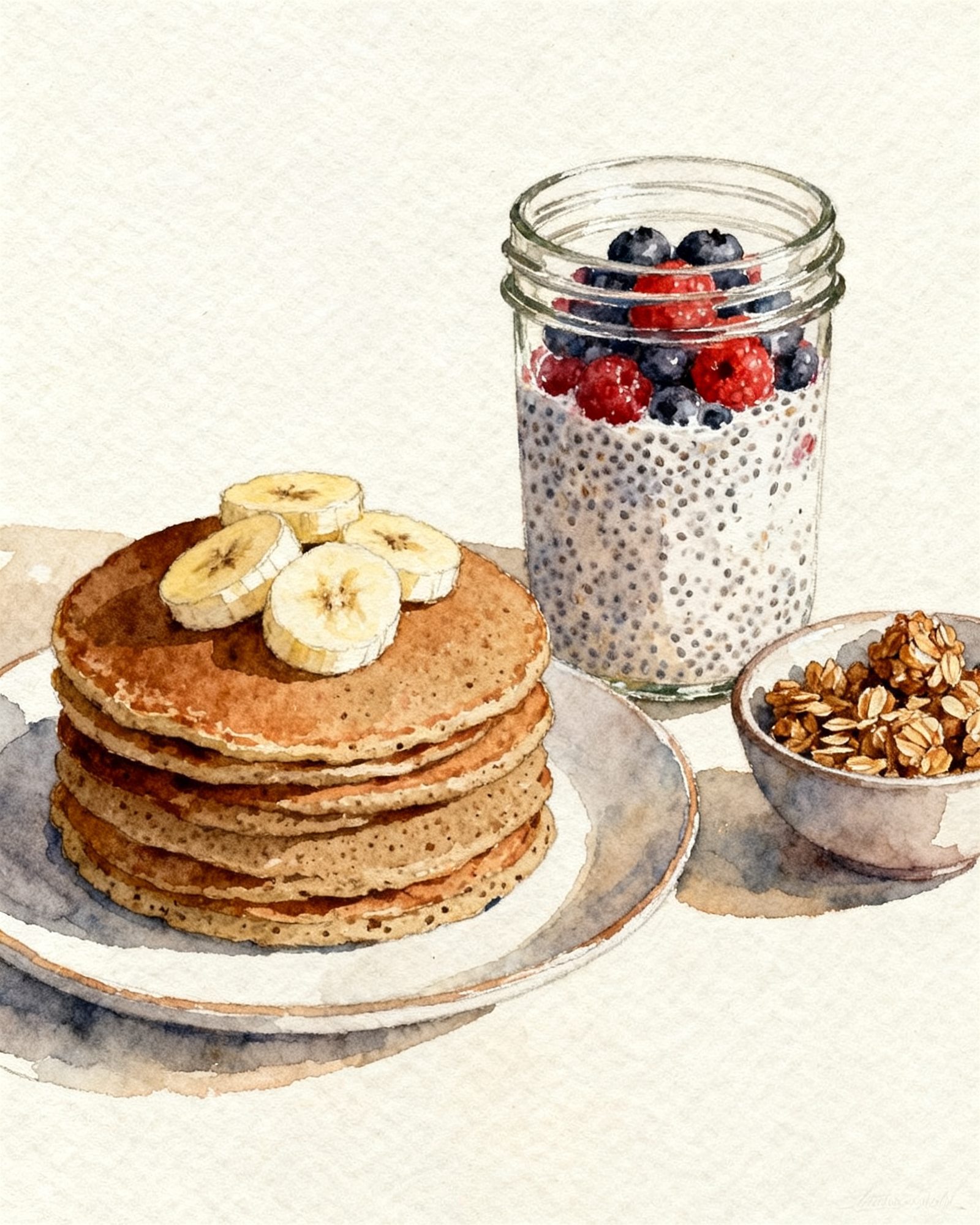
Granola is a crunchy topping as much as a cereal: scatter it over chia pudding just before serving, or over a stack of vegan buckwheat pancakes, and layer it with coconut yogurt and orange in a coconut yogurt parfait.
Common questions
How do I get big clusters in homemade granola?
Press the coated oats into a firm, compact layer on the pan, bake without stirring, and let the granola cool completely before you touch it. The maple syrup sets hard as it cools and glues the oats together; breaking the slab up while it is still warm leaves you with loose crumbs.
Why is my granola soft and not crunchy?
Either it was underbaked or it was put into a jar before it had cooled. Granola is still soft when it comes out of the oven and crisps over the next 45 minutes. If it is still chewy once completely cool, spread it out and bake it at 325°F (165°C) for a few more minutes.
Can I make granola without oil?
You can, but it bakes up drier, paler and less crisp, and it tends to stick to the parchment. The oil coats the oats so they toast evenly. If you cut it back, keep at least half of it.
How do I make chocolate granola?
Add unsweetened cocoa powder and a little extra maple syrup to the syrup mixture; the exact amounts are in the chocolate granola section. Bake and cool it exactly like the plain version, and judge it by smell and dry, firm edges, since the cocoa hides the color.
How long does homemade granola keep?
In an airtight jar at room temperature it stays crisp for a couple of weeks. Once it softens or the almonds taste stale, it is past its best. Keep it away from the stove and other warm, humid spots.
Sources
Read next
Vegan buckwheat pancakes, light and fluffy
Fluffy vegan buckwheat pancakes with no eggs or dairy: how the batter rises, why it rests 10 minutes, when to flip, a banana option, and freezing tips.
Chia pudding: the ratio, the method and five flavors
How to make chia pudding that sets thick and smooth: the 1-to-4 ratio of seeds to plant milk, the second stir that stops clumps, flavors and storage.
Natural sweeteners compared: maple, dates, coconut sugar
What maple syrup, agave, coconut sugar, dates, molasses and stevia are, how the FDA and Dietary Guidelines treat them, and how each one behaves in baking.
What is nutritional yeast and how to use it
Nutritional yeast explained: what the flakes are, fortified vs unfortified, how much vitamin B12 the NIH lists, the niacin caution, and how to cook with it.
Vegan bean chili: thick, smoky and made with three beans
A thick vegan chili with kidney, black and pinto beans: blooming the spices, what thickens it, canned vs. dried beans done safely, toppings and freezing.